23 OCT 2025 - We are back! If you have been following us over the last few years, you will know that the last 2 months have been rough. We website was practically not loading. Sorry for the mess. We are back though and everything should run smoothly now. New servers. Updated domains. And new owners. We invite you all to start uploading torrents again!
TORRENT DETAILS
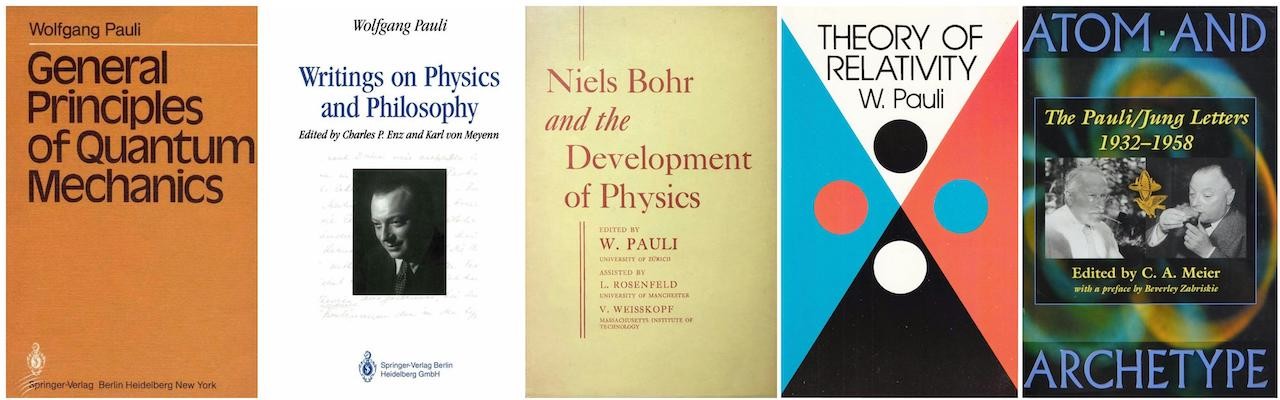
Pauli, Wolfgang - Collected Works In Physics (22 Books)
* Wolfgang Pauli - Collected Works in Physics (22 books)
WOLFGANG PAULI (1900–1958) was an Austrian theoretical physicist, renowned not only for his pioneering work in quantum mechanics but also for his sharp intellect and demanding scientific standards. Born in Vienna in 1900, Pauli rose to prominence early, publishing a major review of Einstein’s theory of relativity at just 21. Though not as publicly visible as contemporaries like Einstein or Bohr, Pauli shaped the course of modern physics through both original research and his critical engagement with the work of others.
Pauli's most famous scientific achievement came in 1925, when he formulated the Pauli Exclusion Principle , which states that no two fermions—such as electrons—can occupy the same quantum state within a quantum system. This principle revolutionized atomic theory by explaining the structure of the periodic table and the stability of matter and led to his being awarded the 1945 Nobel Prize in Physics. His subsequent work on electron spin and quantum statistics laid foundational groundwork for quantum field theory. To describe spin mathematically, Pauli introduced what are now called the Pauli matrices, tools still used in quantum mechanics courses around the world.
While Pauli published fewer stand-alone research papers than some of his peers, he authored several enduring works that have educated generations of physicists. His GENERAL PRINCIPLES OF QUANTUM MECHANICS (published in English in 1980 from earlier lectures) is a dense but rigorous text, reflecting his commitment to clarity and formal precision. It presents a systematic treatment of non-relativistic quantum theory and has been praised for its conceptual depth. Robert Oppenheimer called it "the only adult introduction to quantum mechanics." The six-volume PAULI LECTURES ON PHYSICS (1973)—compiled posthumously from his Zurich lectures—cover a range of topics including statistical mechanics, thermodynamics, and quantum theory. Other notable publications include MESON THEORY OF NUCLEAR FORCES (1946, revised 1948) and WRITINGS ON PHYSICS AND PHILOSOPHY (1994).
Pauli also famously collaborated with C. G. Jung, exploring the intersection of physics and psychology (see his 1952 essay, "The Influence of Archetypal Ideas on the Scientific Theories of Kepler" ), and the letters they exchanged were published as ATOM AND ARCHETYPE (2001). Jung's elaborate analysis of more than 400 of Pauli's dreams is documented in his "Psychology and Alchemy" (1944) and included in my Jung torrent (see link below).
Beyond formal publications, much of Pauli’s intellectual legacy survives through his extensive correspondence, particularly with Niels Bohr, Werner Heisenberg, and Albert Einstein. Karl von Meyenn’s critical edition of the SCIENTIFIC CORRESPONDENCE (1979-2005) runs to eight volumes, most of which are only available in German.
The following books are in PDF unless otherwise noted:
* General Principles of Quantum Mechanics (Springer, 1980)
* Meson Theory of Nuclear Forces [2e] (Interscience, 1948)
* Physical Chemistry in the Service of Medicine [tr. Fischer] (Wiley, 1907)
* Theory of Relativity [tr. Field] (Dover, 1981) – PDF + ePUB
* Writings on Physics and Philosophy [ed. Enz] (Springer, 1994)
== PAULI LECTURES ON PHYSICS ==
* Volume 1: Electrodynamics (MIT, 1973)
* Volume 2: Optics and the Theory of Electrons (MIT, 1973)
* Volume 3: Thermodynamics & Kinetic Theory of Gases (MIT, 1973)
* Volume 4: Statistical Mechanics (MIT, 1973)
* Volume 5: Wave Mechanics (MIT, 1973)
* Volume 6: Selected Topics in Field Quantization (MIT, 1973)
== SCIENTIFIC CORRESPONDENCE [DE / EN] ==
* Volume I: 1919-1929 [ed. von Meyenn] (Springer, 1979)
* Volume II: 1930-1939 [ed. von Meyenn] (Springer, 1985)
* Volume III: 1940-1949 [ed. von Meyenn] (Springer, 1993)
* Volume IV.1: 1950-1952 [ed. von Meyenn] (Springer, 1996)
* Volume IV.2: 1953-1954 [ed. von Meyenn] (Springer, 1999)
* Volume IV.3: 1955-1956 [ed. von Meyenn] (Springer, 2001)
* Volume IV.4.A: 1957 [ed. von Meyenn] (Springer, 2005)
* Volume IV.4.B: 1958 [ed. von Meyenn] (Springer, 2005)
== OTHER LETTERS ==
* Atom and Archetype: Pauli-Jung Letters, 1932-1958 (Routledge, 2001)
* Standing Together in Troubled Times: Unpublished Letters of Pauli et al. [ed. Shifman] (World Scientific, 2017)
== EDITOR ==
* Niels Bohr and the Development of Physics (Pergamon, 1955)
SEE ALSO:
* Carl Gustav Jung - Collected Works and Letters (62 books)