10 JUL 2026 - Back up to full speed! Let's be honest: for the last few months, TorrentFunk was painfully slow. Pages crawled, searches dragged, and just loading the site tested everyone's patience. We hunted the problem down to our network and rebuilt it from the ground up — smarter caching, a much bigger and faster connection, and a lot of fine-tuning under the hood. The difference is night and day: the site now loads in a fraction of a second. No more waiting around. Thanks for sticking with us through the slow spell. Now go discover your funk!
The popular, brief rhetoric that treats writing as thinking, WRITING ANALYTICALLY, Fifth Edition, offers a series of prompts that lead you through the process of analysis and synthesis and help you to generate original and well-developed ideas. The book's overall point is that learning to write well means learning to use writing as a way of thinking well. To that end, the strategies of this book describe thinking skills that employ writing. As you will see, this book treats writing as a tool of thought--a means of undertaking sustained acts of inquiry and reflection.
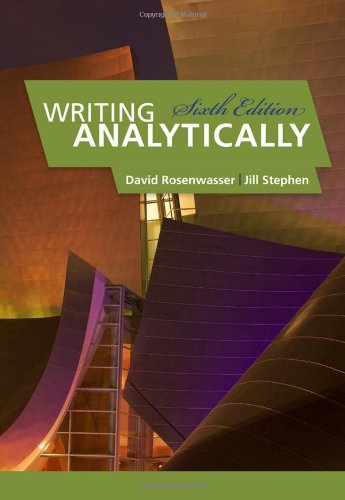
The popular, brief rhetoric that treats writing as thinking, WRITING ANALYTICALLY, Sixth Edition, offers a series of prompts that lead you through the process of analysis and synthesis and help you to generate original and well-developed ideas. The book's overall point is that learning to write well means learning to use writing as a way of thinking well. To that end, the strategies of this book describe thinking skills that employ writing. As you will see, this book treats writing as a tool of thought--a means of undertaking sustained acts of inquiry and reflection.
Publisher: Wadsworth Publishing Co Inc; 7th Revised edition edition (15 April 2014)
Language: English
ISBN-10: 1285436504
ISBN-13: 978-1285436500
Treating writing as thinking, the popular Writing Analytically, 7e delivers a sequence of specific prompts that teach students across the curriculum how the process of analysis and synthesis is a vehicle for original and well-developed ideas. The governing premise of this concise rhetoric is that learning to write well means learning to use writing in order to think well. The book treats writing as a tool of thought - a means of undertaking sustained acts of inquiry and reflection. An all-new Chapter 1 "Introduction to This Book, to College Writing, and to Thinking About Thinking" shows students how they can best utilize the text and its features to maximize their academic success. Two all-new "Toolkit" chapters help students sharpen their problem-solving skills. In addition, a fully revised and expanded chapter on reading offers a more developed presentation of "How to Read" as well as exercises to practice the reading-writing connection presented in the chapter.
About the Author
David Rosenwasser teaches at Muhlenberg College, a small liberal arts college in Pennsylvania, where he has been since the late 1980s. Along with Jill Stephen, he created and implemented the Writing Across the Curriculum program there through a series of faculty seminars. During these seminars, Rosenwasser and Stephen discovered that content faculty from across the disciplines, although they maintained disciplinary-specific writing protocols, essentially wanted the same thing from student writing: analysis. From this premise, their textbook, WRITING ANALYTICALLY, was born. Rosenwasser received his B.A. from Grinnell College and his Ph.D. from the University of Virginia in the theory and history of narrative. His current interests include contemporary Irish literature and comic theory. His most recent literary papers include a study of the contemporary Irish writer Edna O'Brien in relation to the work of Joyce and Yeats, and an analysis of the politics of Bruce Springsteen's albums during the Bush presidency, written collaboratively with a political science professor.